Epoxies Versus Polyaspartics
Epoxy vs. Polyaspartic Flooring: Which Floor Coating Is Best for Your Garage or Commercial Space?
When researching floor coating systems, one of the most common questions homeowners and business owners ask is:
Should I choose epoxy or polyaspartic flooring?
The truth is that both materials offer excellent performance when installed correctly. However, understanding the strengths of each coating can help you make an informed decision for your garage, basement, warehouse, restaurant, showroom, or commercial facility.
At Apex Custom Coatings, we utilize both epoxy and polyaspartic technology because each product excels in different areas. The best flooring systems often combine the strengths of both materials rather than relying on a single coating.
What Is Epoxy Flooring?
Epoxy flooring is a resin-based coating that bonds directly to properly prepared concrete. For decades, epoxy has been used in residential, commercial, and industrial environments because of its exceptional adhesion, durability, and versatility.
Benefits of Epoxy Flooring
- Superior adhesion to concrete
- Excellent compressive strength
- Cost-effective installation
- Wide variety of colors and decorative finishes
- Ideal base coat for flake, quartz, and metallic systems
- Excellent chemical resistance
- Long-term durability
Epoxy remains one of the most trusted flooring materials in the industry and serves as the foundation of many high-performance floor coating systems.
What Is Polyaspartic Flooring?
Polyaspartic coatings are an advanced coating technology originally developed for demanding industrial applications. Today, polyaspartic coatings are widely used in residential garages, commercial facilities, restaurants, warehouses, and exterior concrete surfaces.
Benefits of Polyaspartic Flooring
- Rapid cure times
- UV stability and non-yellowing performance
- Exceptional abrasion resistance
- Excellent chemical resistance
- Greater flexibility than traditional epoxy
- Faster return to service
- Superior gloss retention
Polyaspartic coatings are often used as the protective topcoat in premium floor coating systems because they provide outstanding long-term protection against wear, chemicals, and sunlight.
Epoxy vs. Polyaspartic: Key Differences
Installation Time
One of the biggest differences between epoxy and polyaspartic flooring is curing speed.
Traditional epoxy systems typically require longer cure times, while polyaspartic coatings cure significantly faster. This allows many projects to be completed and returned to service much sooner.
Winner: Polyaspartic
UV Resistance
Epoxy coatings naturally amber and yellow over time when exposed to ultraviolet light.
Polyaspartic coatings are UV stable and maintain their color and gloss much longer, making them ideal for garages, patios, and spaces with direct sunlight exposure.
Winner: Polyaspartic
Chemical Resistance
Both coatings provide excellent protection against chemicals and stains. However, polyaspartic coatings generally offer superior resistance to automotive fluids, cleaning products, and commercial contaminants.
Winner: Polyaspartic
Cost
Epoxy systems are generally less expensive than polyaspartic systems due to lower material costs.
For customers seeking the most economical coating solution, epoxy remains an excellent option.
Winner: Epoxy
Durability
Both systems are extremely durable when professionally installed.
Epoxy provides exceptional adhesion and structural strength, while polyaspartic offers superior abrasion resistance, flexibility, and UV protection.
Winner: Tie
Why We Prefer an Epoxy Base Coat
One of the biggest misconceptions in the flooring industry is that faster curing automatically means a better floor.
While polyaspartic coatings offer incredible performance as a finish coat, epoxy continues to be the industry standard for bonding directly to concrete.
Superior Concrete Adhesion
Concrete is naturally porous and contains thousands of microscopic voids and capillaries beneath the surface.
Because epoxy cures more slowly than polyaspartic, it has more time to penetrate into the prepared concrete surface before hardening. This allows the epoxy to create a stronger mechanical bond with the concrete substrate.
Polyaspartic coatings cure much faster. While this rapid cure is excellent for reducing downtime, it also gives the material less time to penetrate deeply into the concrete before cross-linking and hardening.
Why This Matters in Real-World Conditions
Most concrete slabs are far from perfect.
Even after professional grinding, concrete can vary in:
- Density
- Porosity
- Age
- Moisture exposure
- Previous contamination
- Surface hardness
Because epoxy has more time to wet out and penetrate these varying conditions, it often develops stronger adhesion to the concrete surface.
This becomes especially important in:
- Residential garages exposed to hot tire pickup
- Commercial facilities with rolling loads
- Restaurants and retail spaces with constant foot traffic
- Older concrete slabs
- Floors exposed to seasonal temperature changes
A stronger bond to the concrete means the entire flooring system starts with a more reliable foundation.
Why We Use Both Epoxy and Polyaspartic
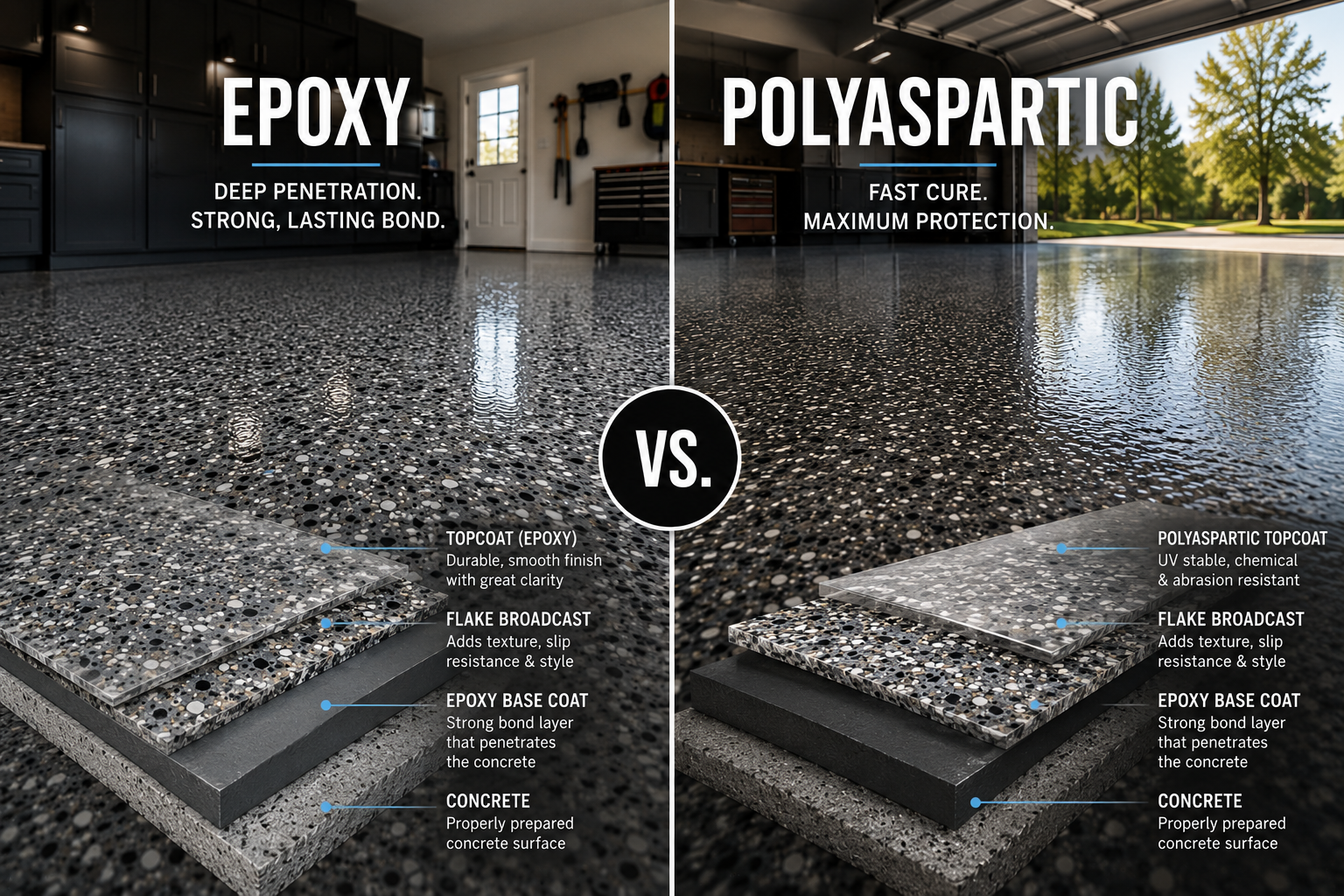
Rather than choosing one material over the other, the highest-performing flooring systems utilize the strengths of both.
At Apex Custom Coatings, our most popular systems typically include:
- Professional concrete preparation
- High-performance epoxy base coat
- Decorative flake or quartz broadcast
- Polyaspartic topcoat for long-term protection
This combination allows homeowners and business owners to benefit from:
- Superior concrete adhesion
- Excellent durability
- UV stability
- Chemical resistance
- Abrasion resistance
- Long-lasting appearance
Simply put:
Epoxy provides the foundation. Polyaspartic provides the protection.
Which Flooring System Is Right for You?
Every project is different.
If you're looking for a cost-effective coating solution, epoxy may be the right fit.
If you want maximum UV protection, faster cure times, and superior wear resistance, polyaspartic coatings offer significant advantages.
For most residential and commercial applications, a professionally installed system that combines both epoxy and polyaspartic technology delivers the best overall performance and longevity.
Get a Free Floor Coating Estimate
Whether you're considering a garage floor coating, decorative flake floor, metallic epoxy floor, quartz flooring system, or commercial concrete coating, Apex Custom Coatings can help you select the right solution for your project.
We proudly serve the Denver Metro area with professional floor coating systems designed to perform for years to come.
Contact Apex Custom Coatings today to schedule your free consultation and estimate.